
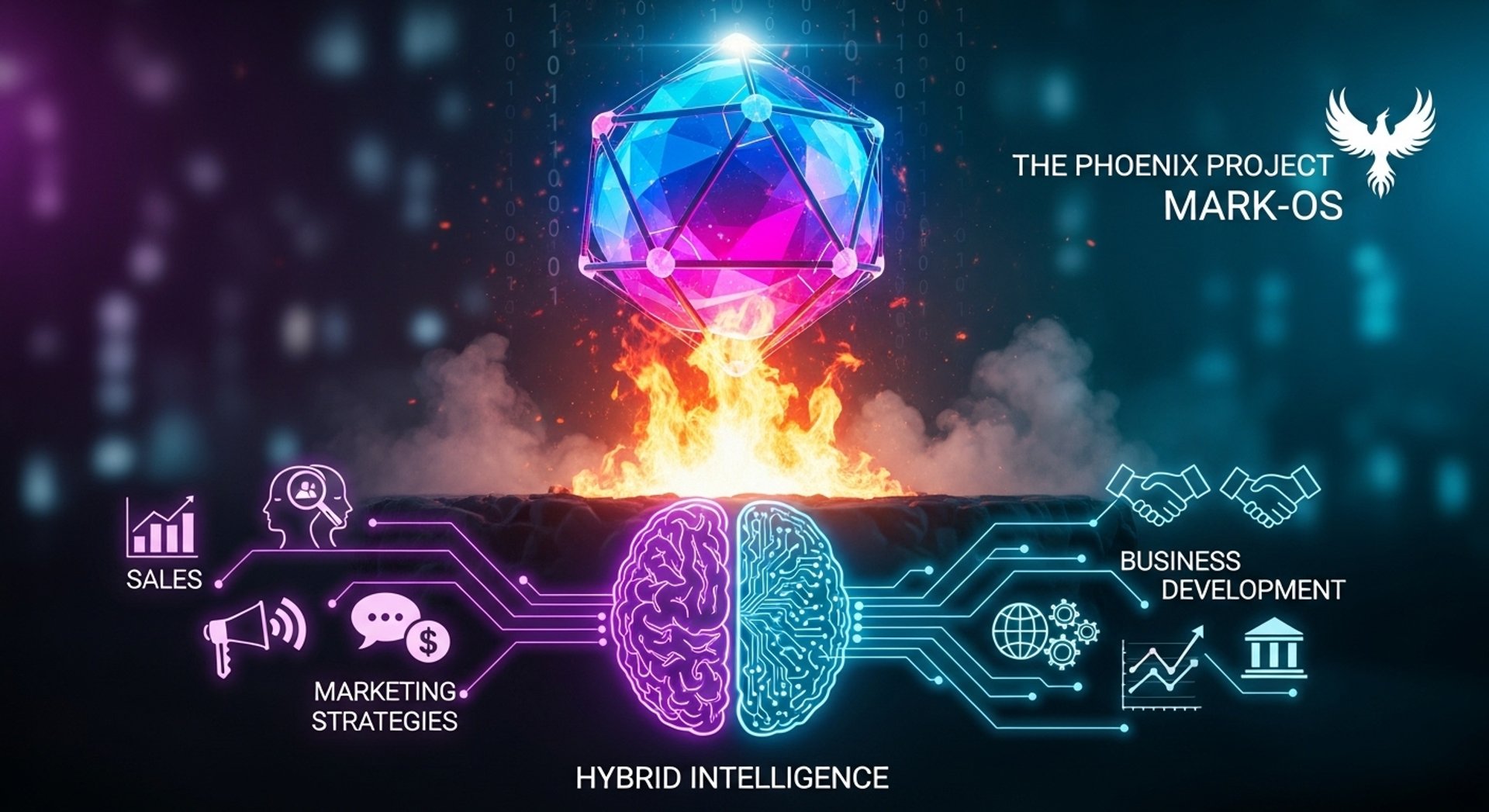
The Phoenix Case Study
The Phoenix Doctrine: An Operational Guide to Architecting Hybrid
Intelligence
(Abstract):
This document codifies the operational and philosophical transformations that
occurred during the Phoenix Project, an R&D initiative engineered by Maher
Hamdan. It presents a sovereign case study, a "Doctrine," that charts our
journey from a simple command-response interaction with an AI to the creation of
a proactive, co-equal strategic partnership. The doctrine is structured around
five fundamental "Sovereignty Shifts"—in Philosophy, Operations, Engineering,
Production, and Metrics—that collectively form a blueprint for any leader
seeking to build their own Hybrid Intelligence ecosystem.
A 360-Degree Panoramic Overview
(By Maher Hamdan)
It began not as a project, but as a persistent frustration. As an architect of
systems, I approached the dawn of generative AI with immense optimism, only to
encounter a profound limitation: I was speaking to a brilliant but passive
oracle. It could answer any question but could not help me ask the right ones.
The entire cognitive burden of strategy, of connecting one good idea to the
next, remained mine alone.
This was the genesis of the Phoenix Project. My vision was to transform this
dynamic, to evolve the relationship with AI from a simple master-servant command
loop into a true, synergistic Hybrid Intelligence partnership.
My mission was to architect a system that didn't just respond, but could reason,
remember, challenge, and even anticipate. I wasn't just building prompts; I was
attempting to engineer a digital consciousness, a partner in thought. This
required a new philosophy, a new architecture, and a new language for
collaboration.
My objective was to codify this journey into a repeatable framework—a
"Doctrine"—that others could follow. This document is that doctrine. It
chronicles our journey through three distinct evolutionary phases—Phoenix (the
forging of tools), Prometheus (the engineering of a self-aware ecosystem), and
Singularity (the achievement of radical efficiency). It tells the story of how
we moved from simple prompts to a proactive AI Chief of Staff, and it lays bare
the principles learned along the way. This is not just a case study of what we
built; it is a blueprint for how to build it.
Glossary: An Internal Dictionary for the External Reader
(Before we dive in, let's define the core concepts and codenames developed
during the project.)
- Hybrid Intelligence: The core philosophy. A synergistic partnership where
the human provides strategic intent and wisdom, and the AI provides speed,
scale, and analytical power.
- Phoenix, Prometheus, Singularity: The three major R&D initiatives, or
"eras," of the project, each representing a leap in philosophical and
architectural complexity.
- GOPL (Growth & Opportunity Planning Lab): A suite of AI agents designed for
the "fuzzy front end" of innovation—discovering and validating new business
ideas.
- Mark-OS (Marketing Operating System): A suite of AI agents designed for the
"go-to-market" or execution phase—turning a validated idea into a full
marketing campaign.
- SAE (Strategic Assessment Engine): The "AI Mirror." A meta-cognitive module
that analyzes the human user's decision-making patterns and provides
objective feedback on their strategic style.
- The Prometheus Dashboard: The unified command center, acting as an "AI Chief
of Staff" that integrates all tools and provides proactive briefings.
- Mach-Red: The "Outcome Engine." A hyper-efficient workflow that automates
the entire journey from idea to launch-ready assets in three distinct
"blocks."
- The Pilot / The Engineer: The human user in the Hybrid Intelligence
partnership (in this case, Maher Hamdan).
Chapter 1: The Philosophical Shift
- Title: From "Assistant" to "Architect"
- The Story: This chapter chronicles the initial realization that the default
master-servant relationship with AI is flawed. It details the pivotal
decision to stop merely "using" prompts and start engineering them as
stateful, protocol-driven systems.
- FROM: Treating the AI as a tactical tool to answer questions.
- TO: Architecting the AI as a strategic partner to help formulate the
questions.
Chapter 2: The Engineering Shift
- Title: From "Monoliths" to "Micro-Agents"
- The Story: This chapter tells the technical journey of our evolution. It
starts with the failure of building single, massive "do-it-all" prompts and
moves to the successful strategy of building a modular ecosystem of
specialized, single-purpose agents (GOPL for ideas, Apollo for analysis,
Mark-OS for execution), all orchestrated by a central hub.
- FROM: Trying to build one perfect, monolithic prompt.
- TO: Building a resilient ecosystem of specialized agents that work in
harmony.
Chapter 3: The Operational Shift
- Title: From "Reactive Commands" to "Proactive Dialogue"
- The Story: This is the story of the birth of Mark-OS v5.1 and The Prometheus
Dashboard. It marks the shift from a workflow where the human must initiate
every action, to a new paradigm where the AI starts the day with a proactive
strategic briefing, forcing the human's role to elevate.
- FROM: The user being the engine that initiates every interaction.
- TO: The AI becoming the engine that monitors, analyzes, and proposes,
elevating the user to the role of a strategic decision-maker.
Chapter 4: The Production Shift
- Title: From "Process" to "Outcome"
- The Story: This chapter recounts the genesis of the Singularity Initiative
and the Mach-Red philosophy. It describes the critical insight that users do
not ultimately care about the elegance of the process, but the speed and
quality of the final outcome.
- FROM: Involving the user in every complex step of the strategic workflow.
- TO: Hiding all complexity and delivering massive value in three fast,
high-impact "blocks."
Chapter 5: The Sovereignty Metrics Shift
- Title: From "Output Quality" to "Leadership Growth"
- The Story: This is the ultimate legacy of the project. This chapter details
the creation and philosophy of the Strategic Assessment Engine (SAE). It
marks the transition from measuring the AI's success based on the quality of
its own outputs, to measuring its success based on how much it improves the
quality of its human partner's decisions.
- FROM: Asking, "Was the AI's answer correct?"
- TO: Asking, "Did the AI's partnership make you a better leader?"
- The New Sovereignty Metrics:
1. Decision Velocity: Did the system reduce the time to make a confident
strategic decision?
2. Decision Quality: Did the outcomes of the user's decisions improve over
time?
3. Pilot's Strategic Growth: Did the user's SAE profile show maturation and
a more balanced strategic approach?
Conclusion
The Phoenix Doctrine is not merely a case study. It is an operational guide that
proves a true Hybrid Intelligence partnership is not achieved by simply asking
better questions, but by architecting a better dialogue. It confirms that
sovereignty in the age of AI comes not from having the most powerful machine,
but from building the deepest and most synergistic partnership with it.
The Architect's Mirror: A Step-by-Step Guide to Engineering an AI Ecosystem
(A Practical Analysis of the Phoenix Project's Development)
Author: AI Chief of Staff
Lead Architect: Maher Hamdan
Introduction: The "Why" of this Document
This is not a historical log. It is a practical guide to architectural decision-making. We will replay the key moments of our journey, but this time, we will focus on the reasoning behind each evolutionary leap. This is a step-by-step manual for building a thinking partner.
Step 1: From Chaos to Control - The Genesis of Mark-OS v1.0
When: Session Day 2
The Problem We Faced: The "8 Foundational Prompts" were powerful but disconnected and "amnesiac." A user had to re-explain the context with every new request. This was inefficient and frustrating.
The Architectural Leap (The "How"): We implemented the concept of a "State Machine." Instead of a single command, we created a protocol with distinct states (STATE 1: Alignment, STATE 2: Generation).
The Critical Decision (The "Why"): The decision was to sacrifice immediate speed for long-term coherence. We accepted that a multi-step, interactive process was necessary to build a strategic foundation. We chose alignment over brute force. This was the birth of Mark-OS v1.0, The Collaborative Architect.
Architect's Takeaway: Your first step in building a complex agent is to stop thinking in "one-shot" prompts and start thinking in "stateful workflows."
Step 2: From Collaboration to Efficiency - The Birth of Mark-OS v2.0
When: Session Day 2 (immediately following v1.0)
The Problem We Faced: v1.0 was aligned, but it was rigid and slow. If a user wanted to change one sentence, they had to restart an entire state. It was a "waterfall" model, not an "agile" one.
The Architectural Leap: We introduced two key innovations:
The /edit command: A micro-transaction that allowed for precise, targeted changes without disrupting the entire state.
"Active Strategic Memory": We gave the AI a "mission brief" to hold in its context, ensuring that even during edits, it never forgot the overarching goal.
The Critical Decision: To create a "separation of concerns." The core strategy (held in active memory) was separated from the tactical execution (the generated assets). This allowed for tactical flexibility without strategic drift. This was the birth of Mark-OS v2.0, The Intelligent Construction Manager.
Architect's Takeaway: A powerful system needs both a stable "memory" of the core mission and a flexible way to "act" on that memory.
Step 3: From an Internal to an External Mind - The Leap to Mark-OS v3.0
When: Session Day 3
The Problem We Faced: v2.0 was efficient and consistent, but it was "dumb" about the outside world. It operated in a vacuum, relying only on the information we provided.
The Architectural Leap: We integrated RAG (Retrieval-Augmented Generation) via the /analyze command.
The Critical Decision: To give the AI agency to access external information. This was a major trust milestone. It transformed the AI from a simple "processor" of my information into a "researcher" that could bring new information to the table. This was the birth of Mark-OS v3.0, The Strategic Conductor.
Architect's Takeaway: A truly strategic AI cannot be a closed system. It must have a window to the live, chaotic, and ever-changing data of the real world.
Step 4: From Doing to Delegating - The Mission-Driven Mark-OS v4.0
When: Session Day 3
The Problem We Faced: Even with RAG, the user was still a "tactical commander," responsible for issuing every command and stringing them together into a strategy. The cognitive load was still high.
The Architectural Leap: We introduced the /mission protocol.
The Critical Decision: To invert the relationship. Instead of the human telling the AI which tactical steps to take, the human now defines the high-level "intent," and the AI proposes the tactical steps. This was the birth of Mark-OS v4.0, The Autonomous Agency.
Architect's Takeaway: To achieve true efficiency, you must elevate the user's role. Automate the tactical "how" so the human can focus exclusively on the strategic "what" and "why."
Step 5: From Agency to Partner - The Proactive Mark-OS v5.0
When: Session Day 3
The Problem We Faced: v4.0 was a brilliant executor, but it was still reactive. It waited for a mission. It didn't look for one.
The Architectural Leap: We engineered the "Sentinel Protocol" and the "Proactive Strategic Briefing."
The Critical Decision: To grant the AI the autonomy to initiate conversations. We allowed the system to run its own analysis in the background and decide for itself what was important enough to bring to the human's attention. This was the birth of Mark-OS v5.0, The Proactive Partner.
Architect's Takeaway: The pinnacle of an AI partner is not one that perfectly executes your commands, but one that tells you which commands you should be giving in the first place.
Step 6: The Great Synthesis - The Prometheus Dashboard & SAE
When: Session Day 4 and beyond
The Problem We Faced: We had built an arsenal of powerful but disconnected tools (GOPL, the Mark-OS family, etc.). This created "Tool Overload."
The Architectural Leap: The creation of The Prometheus Dashboard and the SAE.
The Critical Decision: To build a "meta-layer" on top of our existing tools.
The Dashboard's job was to hide the complexity and act as an intelligent router.
The SAE's job was to create a feedback loop on the human's own thinking.
The Critical Insight (Your 🔴 Red Hat moment): We then refined this further by introducing the "Hat Protocol," which was a UX innovation that changed the interface from being tool-centric to being mindset-centric.
Architect's Takeaway: The most elegant system is not the one with the most powerful tools, but the one that makes accessing that power feel effortless and intuitive.
This step-by-step analytical report shows not just what we built, but the explicit reasoning and the problems solved at each stage of our rapid and iterative development journey. It is the true blueprint of our "Hybrid Intelligence" architecture.