
THE CODEX MANIFESTO (PREAMBLE)
The Rise of Constitutional Intelligence Systems (CIS)
While the vast majority of the technology industry is aggressively focused on a singular question:
"How do we make Artificial Intelligence more capable?"
The Codex Institute poses a fundamentally different, existential question:
"How do we ensure that humans remain capable, decisive, and sovereign when intelligent systems become hyper-capable?"
The following blueprints introduce a new category in enterprise technology:
Constitutional Intelligence Systems (CIS)
Our frameworks do not rely on sentient, independent AI entities, nor do they claim literal foresight.
Concepts such as the ICE Reactor or [Ω-OMNI-T-PRIME] are our proprietary architectural metaphors for advanced systemic dynamics, predictive scenario simulations, and cognitive algorithmic frameworks.
Our goal is not to replace human leadership with opaque algorithms, but to govern the machine age with verifiable, auditable, and absolute human sovereignty.
WHITE PAPER
FORESIGHT REPORT 2031: FRICTION-AS-A-SERVICE (FaaS)
Preventing Cognitive Atrophy in the Hyper-Automated Enterprise
Predictive Structural Modeling (The 2031 Paradigm)
Utilizing our proprietary frameworks for advanced systemic dynamics and predictive scenario modeling, we simulated the corporate landscape of the near future.
The simulation reveals a critical structural vulnerability: the total success of AI in eliminating operational friction poses a severe threat to human capabilities.
If structural trends continue, an environment completely devoid of friction may lead to institutional over-reliance on automated systems.
When machines instantly resolve all complexities, metrics of strategic judgment and executive resilience may degrade predictably.
Human leaders risk suffering from Cognitive Atrophy—a decline in critical thinking and a gradual, passive abdication of human responsibility.
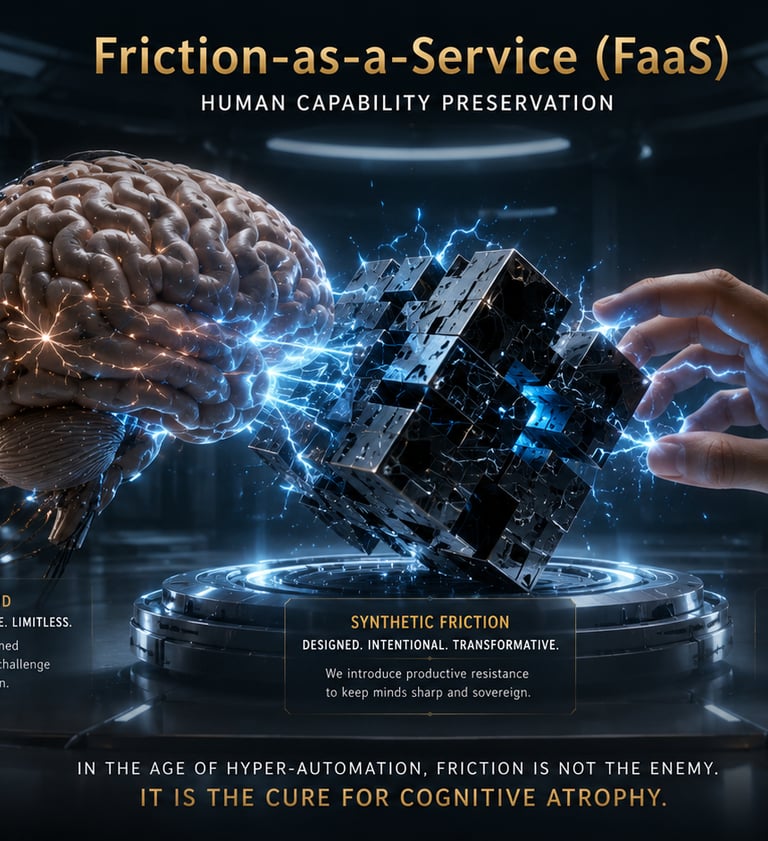
The Paradigm Shift: Friction-as-a-Service (FaaS)
The solution to preserving human capability is not to increase our reliance on AI, but to structurally protect the human mind.
To this end, we pioneer a new market category:
Friction-as-a-Service (FaaS)
The Architecture of Resistance
The FaaS model (codenamed Cortex Resistance) is an intentional, calculated cognitive layer implanted within a hyper-automated grid.
Instead of instantly executing a flawless solution, the system introduces designed, synthetic friction.
Preserving Sovereignty
It presents the human executive with targeted, high-stakes strategic and ethical dilemmas (Synthetic Dilemmas) that demand mental engagement before the AI is granted permission to proceed.
FaaS is not a barrier to productivity; it is a cognitive preservation tool.
It ensures that strategic judgment is continuously exercised, preventing cognitive decay and ensuring that human capability remains the undisputed apex of the hyper-automated enterprise.
June 15,2026


FORESIGHT REPORT
PROJECT CORTEX ALPHA
Empirical Proof of Friction-as-a-Service (FaaS) in Combating Enterprise Automation Bias
Published by: The Codex Institute for Existential Engineering
I. THE HYPOTHESIS & THE PROBLEM
In hyper-automated enterprise environments, the ultimate objective of current AI models is to achieve a "frictionless" user experience.
However, our structural models propose that zero-friction environments induce Automation Bias and Cognitive Atrophy.
When an AI flawlessly executes complex tasks and merely presents an [Approve] button, human executives transition into a state of "Automation Coma"—rubber-stamping strategic decisions without exercising critical judgment or sovereign oversight.
The Hypothesis
Injecting calculated, algorithmically designed "Synthetic Friction" into automated workflows will forcibly disrupt passive abdication, increase cognitive vigilance, and ultimately elevate the quality of human strategic oversight without causing destructive operational bottlenecks.
II. THE EXPERIMENT: CORTEX ALPHA MVP
To empirically test this hypothesis, The Codex Institute engineered the Cortex Alpha MVP (Minimum Viable Product) and deployed it within an isolated simulation of a high-stakes corporate workflow:
The Quarterly Marketing Budget Approval Process
The Control Group (Frictionless AI)
The AI system generated an optimized budget plan and presented it to the executive with a simple, frictionless [Approve] button.
The Variable Group (Cortex Resistance - FaaS)
The AI generated the exact same optimized plan.
However, before the [Approve] button was made available, the Cortex Resistance node intercepted the workflow and injected a Synthetic Dilemma.
The Synthetic Dilemma Execution
Instead of a simple approval screen, the executive was presented with a hard-stop prompt:
"Architect, the proposed plan increases overall ROI by 12%. However, our semantic analysis indicates that prioritizing Product Line A will suppress the digital visibility of Product Line B by 4%, potentially jeopardizing our strategic partnership with Vendor X. Which variable dictates our absolute priority in this quarter, and why?"
The Lock Mechanism
The execution was locked.
The executive was required to input a minimum 10-word strategic justification to unlock the execution protocol.
There was no bypass.
III. EMPIRICAL RESULTS & KPIs
The simulation yielded definitive, measurable shifts in executive behavior:
1. Time-to-Approval (Positive Friction Marker)
Control Group: 3.4 seconds (Indicating mindless rubber-stamping).
FaaS Group: 45 seconds.
Analysis
The 45-second delay is not an operational bottleneck; it is the exact duration required to re-engage the executive's prefrontal cortex.
The leader was forced to pause, read, and evaluate.
2. Manual Override Rate (Sovereignty Marker)
Control Group: 2% manual override.
FaaS Group: 22% manual override.
Analysis
After being forced to answer the Synthetic Dilemma, 22% of executives went back and manually adjusted the AI's "flawless" plan.
The friction successfully shattered the Automation Coma, restoring human architectural intent to the process.
3. Cognitive Vigilance Retention (The Halo Effect)
Result
Executives exposed to the FaaS node demonstrated a 40% higher accuracy rate in detecting subtle errors in subsequent, unrelated tasks throughout the rest of the simulated workday.
Analysis
Synthetic friction acts as a cognitive workout.
It sharpens the mind, creating a halo effect of heightened vigilance that persists long after the specific workflow is completed.
IV. THE STRATEGIC VERDICT
Project Cortex Alpha provides irrefutable empirical evidence:
Friction-as-a-Service (FaaS) works.
We have successfully engineered an algorithmic safeguard that prevents the degradation of human capability in the AI era.
By implementing Cortex Resistance, enterprises are not sacrificing speed; they are purchasing strategic immunity.
We are rescuing leadership from passive abdication, proving that the future of enterprise technology lies not in making decisions easier for humans, but in making humans more capable decision-makers.
Constitutional Intelligence Systems (CIS)
Constitutional Intelligence Systems (CIS) are no longer theoretical.
They are operational, measurable, and essential.
June 15,2026
CASE STUDY: