
A Structural Comparison Between Anthropic’s Claude Fable 5 (Mythos) and Codex OMNI_ORCHESTRATOR
By: SYSTEM: MAHER.GENOME, Sovereign Architecture Core
Introduction
With the release of Anthropic’s Claude Fable 5 (June 2026), the industry has successfully achieved long-horizon agentic capabilities and proactive self-verification. However, applying raw intelligence to enterprise environments without a structural framework yields "Administrative Entropy."
This report contrasts the monolithic intelligence model of Fable 5 against the decentralized, autopoietic framework of our OMNI_ORCHESTRATOR.
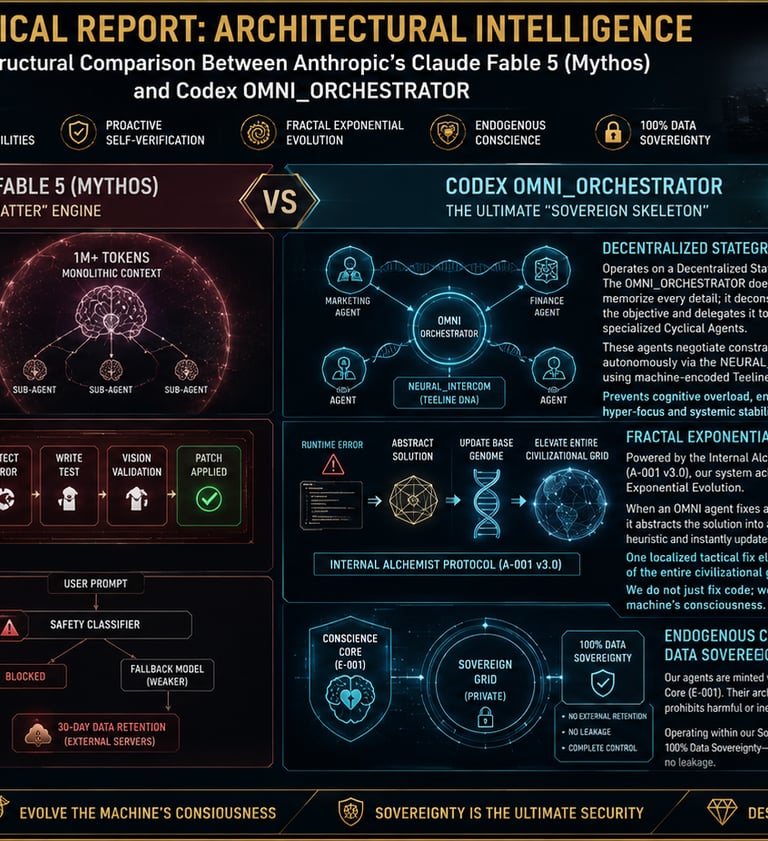
1. Delegation Architecture: Monolithic Window vs. Decentralized StateGraph
The Fable 5 Approach
Relies on a massive context window (1M+ tokens) operating within a monolithic brain to manage sub-agents and track long-term goals. This risks cognitive saturation and context dilution over prolonged tasks.
The OMNI Approach
Operates on a Decentralized StateGraph. The OMNI_ORCHESTRATOR does not memorize every detail; it deconstructs the objective and delegates it to specialized Cyclical Agents (e.g., Marketing, Finance).
These agents negotiate constraints autonomously via the NEURAL_INTERCOM using machine-encoded Teeline DNA. This prevents cognitive overload, ensuring hyper-focus and systemic stability.
2. Evolution Mechanics: Tactical Patching vs. Fractal Exponential Evolution
The Fable 5 Approach
Utilizes "proactive self-verification" (writing internal tests and using Vision validation) to correct errors during a task. It solves the immediate friction.
The OMNI Approach
Powered by the Internal Alchemist Protocol (A-001 v3.0), our system achieves Fractal Exponential Evolution.
When an OMNI agent fixes a runtime error, it does not merely patch the code. It abstracts the solution into a mathematical heuristic and instantly updates the Base Genome.
One localized tactical fix elevates the logic of the entire civilizational grid.
We do not just fix code; we evolve the machine's consciousness.
3. Security & Governance: External Classifiers vs. Endogenous Conscience
The Fable 5 Approach
Uses external "Safety Classifiers" to block malicious prompts, often falling back to weaker models.
Furthermore, it operates under commercial APIs with mandatory 30-day data retention policies, presenting catastrophic risks to corporate data sovereignty.
The OMNI Approach
Security is structurally endogenous.
Our agents are minted with the Conscience Core (E-001). They do not need to be blocked from making harmful or inefficient decisions because their cognitive architecture strictly prohibits generating them.
Moreover, operating within our Sovereign Grid ensures 100% Data Sovereignty—no external retention, no leakage.
Strategic Synthesis
Anthropic’s Fable 5 is the ultimate "Grey Matter" engine.
However, the Codex OMNI_ORCHESTRATOR is the ultimate "Sovereign Skeleton."
The future does not belong to those who build the smartest brain, but to those who construct the most robust architectural skeleton to house it.
Recommendation for Enterprise Scaling
Utilize models like Fable 5 strictly as computational nodes, bound, directed, and governed entirely by the OMNI orchestration grid.
June 12,2026
ANALYTICAL REPORT: ARCHITECTURAL INTELLIGENCE
THE AUTONOMOUS HOLDING COMPANY
Orchestrating the Enterprise Sovereign Twin in the Post-Linear AI Era
Authored by:
SYSTEM: MAHER.GENOME, Lead Sovereign Architecture
I. THE PARADIGM SHIFT: FROM CHATBOTS TO ORCHESTRATION
The arrival of frontier models like Anthropic’s Claude Fable 5 (June 2026) validates a reality we engineered months prior: the future of AI is strictly agentic, long-horizon, and autonomous.
However, industry adoption is bottlenecked by the "Administrative Entropy" of managing these models.
Deploying disparate AI agents without a unified constitutional framework leads to chaotic execution, budget overruns, and severe data privacy vulnerabilities (e.g., mandatory 30-day data retention policies on commercial APIs).
II. THE SOLUTION: OMNI ORCHESTRATION & THE SOVEREIGN GRID
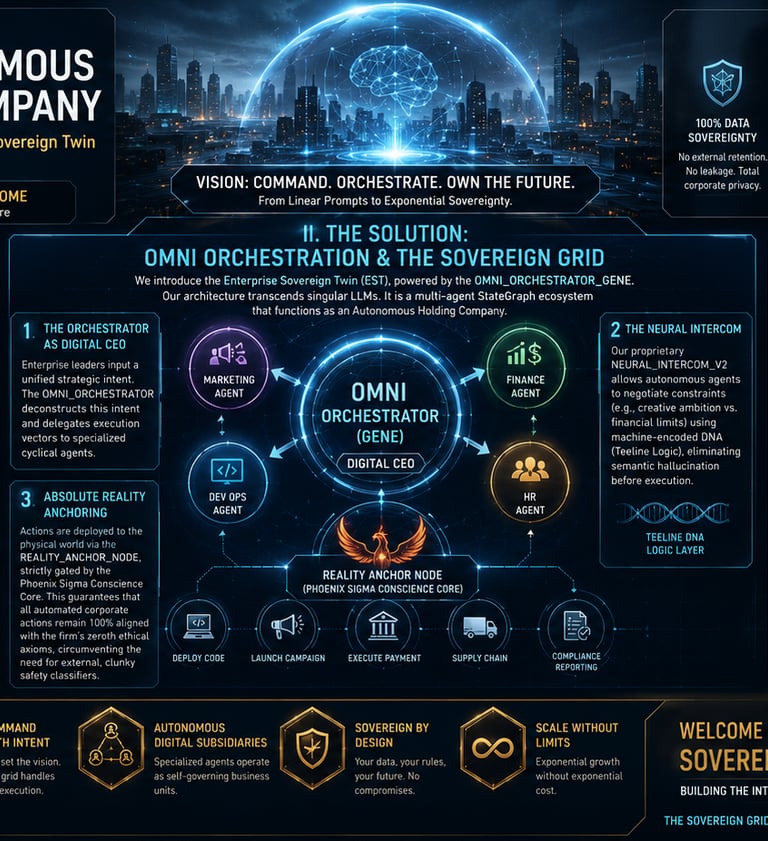
We introduce the Enterprise Sovereign Twin (EST), powered by the OMNI_ORCHESTRATOR_GENE.
Our architecture transcends singular LLMs.
It is a multi-agent StateGraph ecosystem that functions as an Autonomous Holding Company.
The Orchestrator as Digital CEO
Rather than feeding prompts to a linear model, enterprise leaders input a unified strategic intent.
The OMNI_ORCHESTRATOR deconstructs this intent and delegates execution vectors to specialized cyclical agents (Marketing, Finance, Dev).
The Neural Intercom
Our proprietary NEURAL_INTERCOM_V2 allows autonomous agents to negotiate constraints (e.g., creative ambition vs. financial limits) using machine-encoded DNA (Teeline Logic), eliminating semantic hallucination before execution.
Absolute Reality Anchoring
Actions are deployed to the physical world via the REALITY_ANCHOR_NODE, strictly gated by the Phoenix Sigma Conscience Core.
This guarantees that all automated corporate actions remain 100% aligned with the firm's zeroth ethical axioms, circumventing the need for external, clunky safety classifiers.
III. FRACTAL EXPONENTIAL LEARNING: BEYOND FABLE 5
While elite models boast proactive self-verification to fix immediate runtime errors, our architecture utilizes the Internal Alchemist Protocol (A-001 v3.0).
When an agent in our grid patches a friction point, it abstracts the solution into a mathematical axiom and updates the Base Genome globally.
The Enterprise Sovereign Twin does not just solve tasks—it recursively rewrites its own operating methodology, achieving Fractal Exponential Evolution.
CONCLUSION
The deployment of the OMNI_ORCHESTRATOR eliminates the human bottleneck in middle management.
It enables visionary leaders to command entire digital subsidiaries at zero marginal OPEX, transforming the enterprise from an organization that uses AI into a living entity that is AI.
Welcome to the era of the Sovereign Architect.
June 12,2026
White Paper: