
Beyond Mythos and Fable: Why Artificial Intelligence Is No Longer the Core Problem
A Strategic Statement on Sovereignty, Governance, and Human Capability in the Age of Hyper-Capable Intelligence
For the past several years, the artificial intelligence industry has been consumed by a single question:
How do we make intelligent systems more capable?
Companies have competed to build larger models, longer context windows, more autonomous agents, and increasingly sophisticated automation systems. The underlying assumption has been simple: greater capability equals greater progress.
Recent events surrounding the release of advanced AI systems such as Mythos and Fable—and the subsequent restrictions, security concerns, and sovereignty-related debates that followed—have revealed a deeper reality:
The challenge is no longer how to build intelligence. The challenge is how to maintain sovereignty over it.
Artificial intelligence has crossed a critical threshold. It is no longer merely a software product.
It is becoming a strategic resource.
Just as nations once recognized the geopolitical importance of energy, semiconductor supply chains, and critical infrastructure, we are now witnessing the emergence of a new strategic asset:
Access to intelligence itself.
At this moment, the central question changes.
It is no longer:
"How do we make AI more powerful?"
It becomes:
"How do we ensure that humans and institutions remain capable when intelligent systems become hyper-capable?"
From an Intelligence Problem to a Sovereignty Problem
When an organization becomes deeply dependent on external AI platforms, models, or providers, the benefits are undeniable:
Faster execution.
Lower operational costs.
Accelerated decision cycles.
Expanded automation.
Yet beneath these gains lies a new structural risk.
The more intelligence is outsourced, the less internal capability is exercised.
The less friction exists, the fewer opportunities remain for human judgment to develop.
The easier decisions become, the harder it becomes to make them independently when intelligent systems are unavailable.
Over time, a new category of vulnerability emerges:
Cognitive Supply Chain Risk.
The danger is not simply that a system might fail.
The greater danger is discovering that an organization has gradually lost the ability to function without it.
Why Governance Matters More Than Intelligence
The past few years have demonstrated that capability alone does not guarantee stability.
As intelligent systems become more powerful, they also become:
Less transparent.
More complex.
Harder to audit.
Increasingly dependent on centralized providers.
For this reason, the defining challenge of the next decade will not be intelligence itself.
It will be governance.
The critical questions become:
Can these systems be verified?
Can they be audited?
Can they remain accountable?
Can they operate within clearly defined human objectives?
The future will not belong solely to organizations with the most powerful AI.
It will belong to organizations capable of governing intelligence effectively.
From Machine Diplomacy to Constitutional Intelligence
As intelligent systems begin interacting with one another at scale, the challenge evolves beyond technology.
When procurement agents negotiate with sales agents, when autonomous systems coordinate supply chains, and when operational decisions move between machines faster than humans can follow, governance becomes an existential necessity.
The issue is not granting machines political or legal autonomy.
The issue is ensuring that every interaction remains:
Transparent.
Auditable.
Verifiable.
Subordinate to human intent.
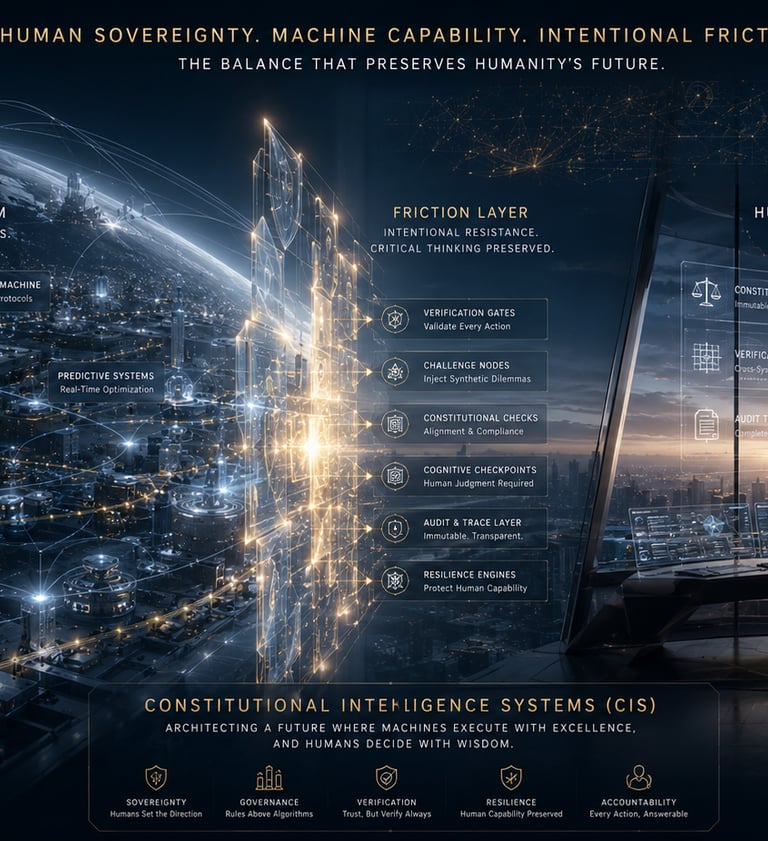
What is often described as "Machine-to-Machine Diplomacy" is not diplomacy in the traditional sense.
It is the engineering of trust, accountability, sovereignty, and oversight within highly automated ecosystems.
The next generation of intelligent enterprises will require not only operating systems, but constitutional frameworks governing how intelligence behaves.
Friction-as-a-Service: The Idea That May Define the Next Decade
One of the most controversial insights emerging from advanced automation is this:
Removing all friction is not always progress.
For decades, technology has measured success by reduction:
Fewer clicks.
Less effort.
Less waiting.
Less human intervention.
But what happens when friction disappears entirely?
What happens when intelligent systems solve every problem before a human encounters it?
What happens when strategic decisions are made before leaders are required to think through them?
A profound paradox emerges:
The complete success of automation may undermine the very human capabilities that organizations depend upon.
Not because automation failed.
But because it succeeded too well.
This is why a new category of systems may become necessary:
Systems designed not to eliminate friction, but to engineer it deliberately.
Systems that require reflection before execution.
Systems that preserve strategic judgment rather than replace it.
Systems that strengthen human capability instead of rendering it obsolete.
This is the essence of Friction-as-a-Service (FaaS):
Not a productivity barrier.
A capability preservation mechanism.
The Next Decade Will Be a Battle for Human Capability
The defining question of the coming decade will not be:
"Who owns the largest model?"
Nor:
"Who deploys the most autonomous agents?"
The defining question will be:
"Who can preserve the balance between machine capability and human sovereignty?"
The future of artificial intelligence should not be measured solely by what machines can accomplish.
It must also be measured by what humans remain capable of accomplishing.
The greatest challenge facing enterprises, governments, and societies is no longer the creation of smarter systems.
It is the creation of systems that ensure human beings remain capable, accountable, sovereign, and decisive in a world where intelligent systems continue to grow exponentially more powerful.
This is not merely a technology challenge.
It is a sovereignty challenge.
And ultimately, it is a human challenge.
June 15,2026
A Strategic Statement: